
The New Prometheus
What the French Revolution tells us about artificial intelligence

I decided to name my newsletter Ideas & Capital because markets and capital, more broadly, are not shaped solely by inflation data, interest rates, unemployment, and other economic indicators.
Markets are also shaped by ideas that evolve into narratives.
More precisely, ideas become beliefs. Beliefs shape behavior, which in turn becomes individual action. Collectively, individual actions become patterns that permeate society.
As society develops new behavioral patterns, capital flows shift accordingly, ultimately affecting prices.
Ideas, capital, and prices are therefore interconnected in a constant feedback loop.
Another way to approach this concept is through what Yanis Varoufakis calls historical materialism: the idea that history evolves through a perpetual cycle of feedback between, on one side, the way humans transform matter and, on the other, the way human thought and social relations are transformed in return.
Bringing this framework into the present moment, which is the central topic of this essay, AI is a technology powerful enough to transform not only our relationship with matter, but also human thought, behavior, and social norms themselves.
There will be a pre-AI world and a post-AI world. There is little doubt about that.
My concern is the degree of freedom we are giving to a technology we may not be able to control in the future. We are building a Frankenstein potentially more powerful than humanity itself, while CEOs disguise and market it as merely a “productivity enhancement”.
In the end, Hesiod may have been right: Zeus may have no choice but to destroy a humanity incapable of restraining its own power once amplified by technology.
We will not become masters of technology. We may simply become enslaved by it.
Technology is the engine that transforms both matter and human thought. Artificial intelligence may accelerate changes in both dimensions faster than any previous period in history.
The Enlightenment created new intellectual foundations that eventually culminated in the French Revolution and the Jacobin Terror.
The Greeks understood this danger before us.
Prometheus stole fire from the gods and gave it to humanity. The gods did not punish him because fire was evil. They punished him because humanity was not ready for it.
We may be living through the same moment again.
This essay is the first in a series exploring how AI may reshape our values and social norms, potentially leading to a new form of revolution.
To better understand the paths that lead to revolution, we must revisit the greatest revolution of the modern era: the French Revolution.
By the end of this essay, I will draw parallels between the Enlightenment, the French Revolution, and the Revolution of Artificial Intelligence.
So let us begin with the Enlightenment and its foundations
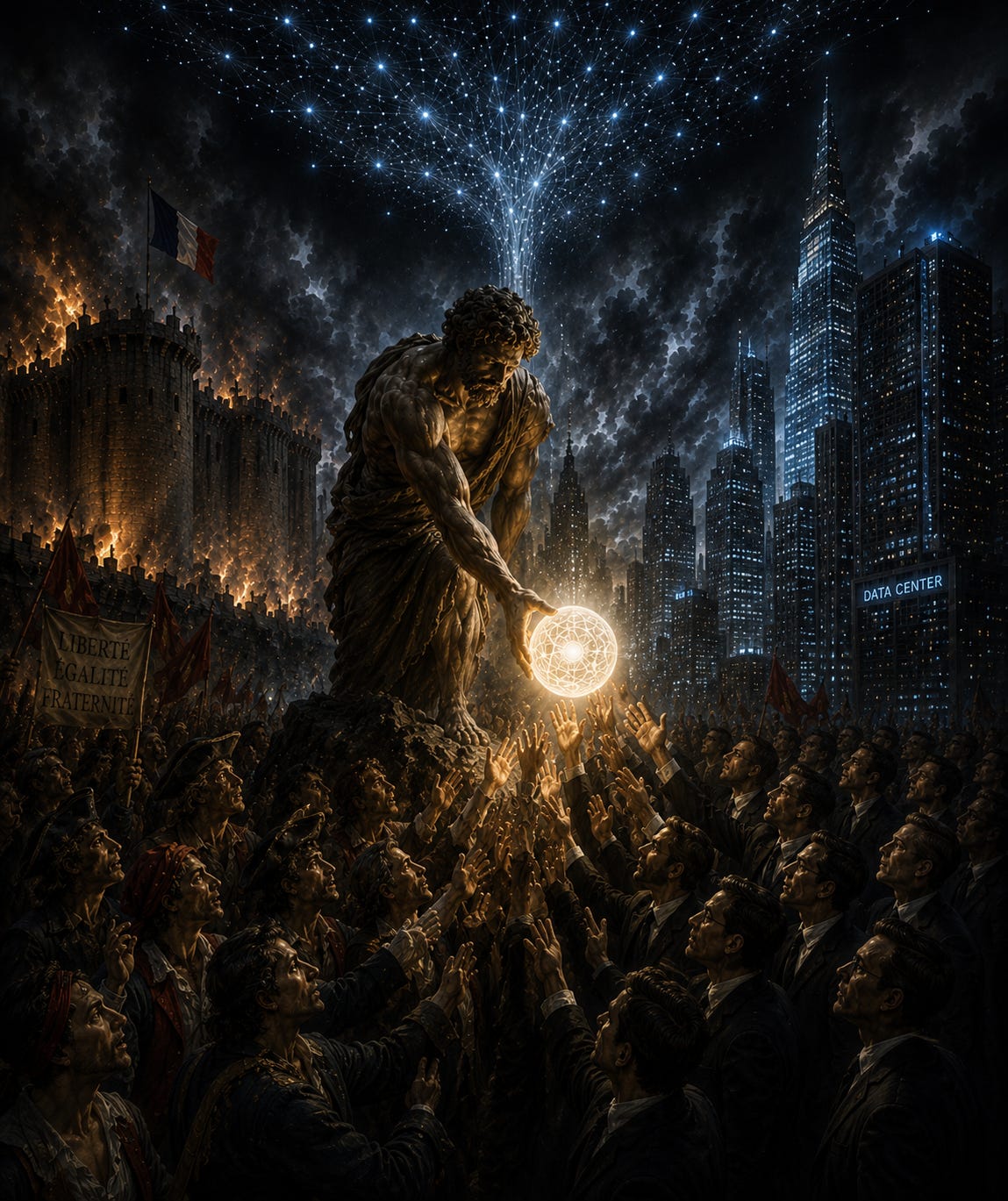
Pre-Enlightenment
The history of thought can be understood as a gradual evolution, punctuated by occasional disruptions to prevailing intellectual frameworks
The Enlightenment was unquestionably one of those disruptions. Arguably, the greatest rupture in the intellectual architecture of the modern world.
Yet if intellectual evolution is continuous and gradual, it is also path-dependent.
Dissident and revolutionary ideas are built upon the foundations of the systems they seek to challenge.
To understand the Enlightenment, we must first understand the foundations upon which it was built.
Its predecessor was the Scientific Revolution.
Returning to historical materialism, we must examine not only science, but also morality and social relations
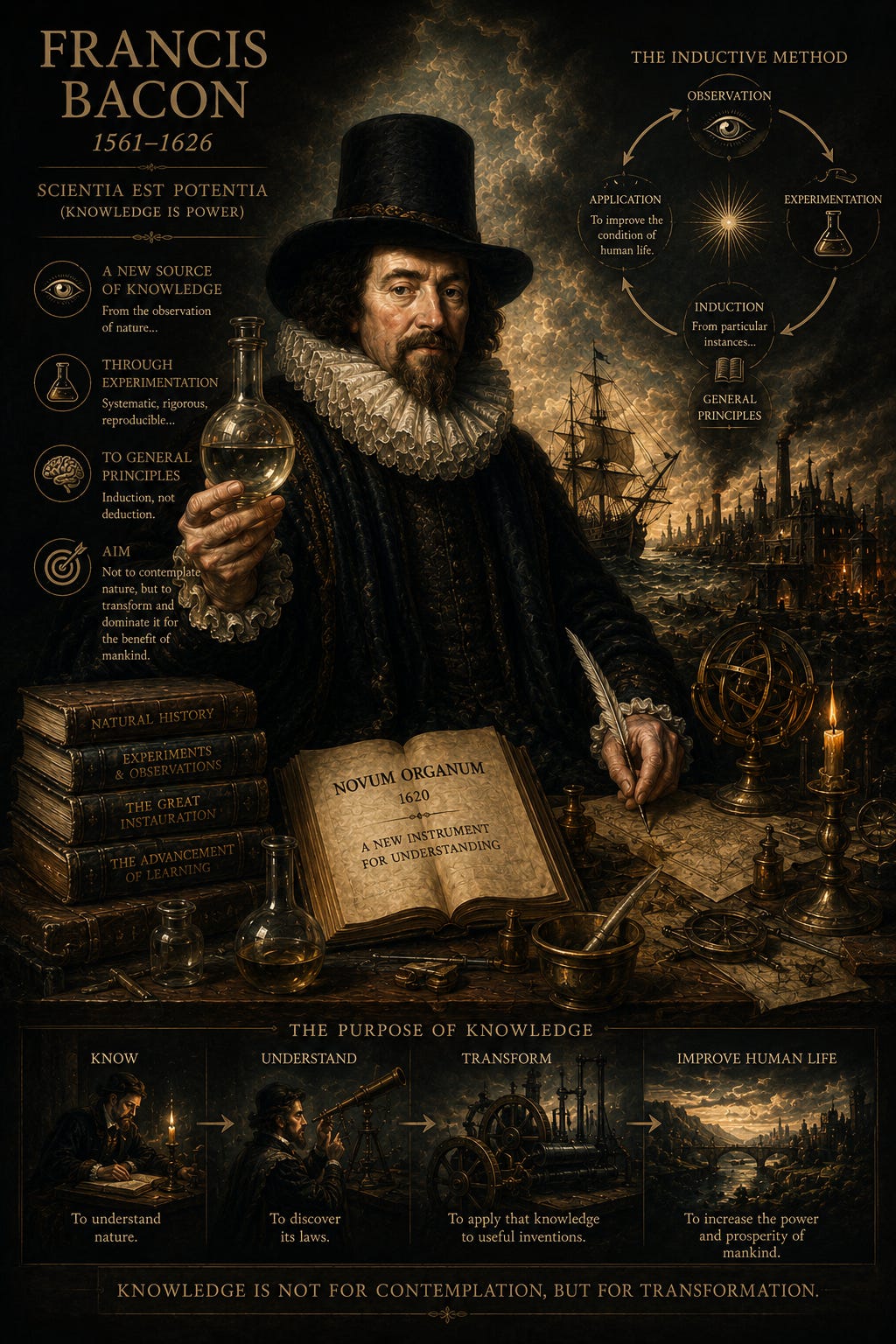
From the scientific perspective, we must begin with Francis Bacon (1561–1626).
Before Bacon, European natural philosophy had been dominated by Aristotle for more than 1,500 years.
The Aristotelian method began with general principles and deduced conclusions from them, observing little and experimenting even less. This was the deductive method.
Bacon turned this framework upside down.
His proposition was simple: knowledge should emerge from systematic observation and experimentation, only then arriving at general principles
In doing so, Bacon established the inductive method.
Scientia est potentia.
Knowledge is power.
The goal was no longer to understand the world merely to contemplate it, as the Greeks had done. The goal was to understand nature in order to transform and dominate it for human benefit.
Bacon did not produce major scientific discoveries himself. He did not formulate physical laws or conduct revolutionary experiments.
His contribution was something else entirely: he redefined what science should be and what it should serve.
That may have been more important than any individual scientific discovery.
This was not merely an intellectual evolution.
It was a rupture.
From this new source of knowledge emerged Copernicus, Galileo, and Newton. Together, they created a new scientific compass for human civilization: the universe operated according to rational laws discoverable by the human mind.
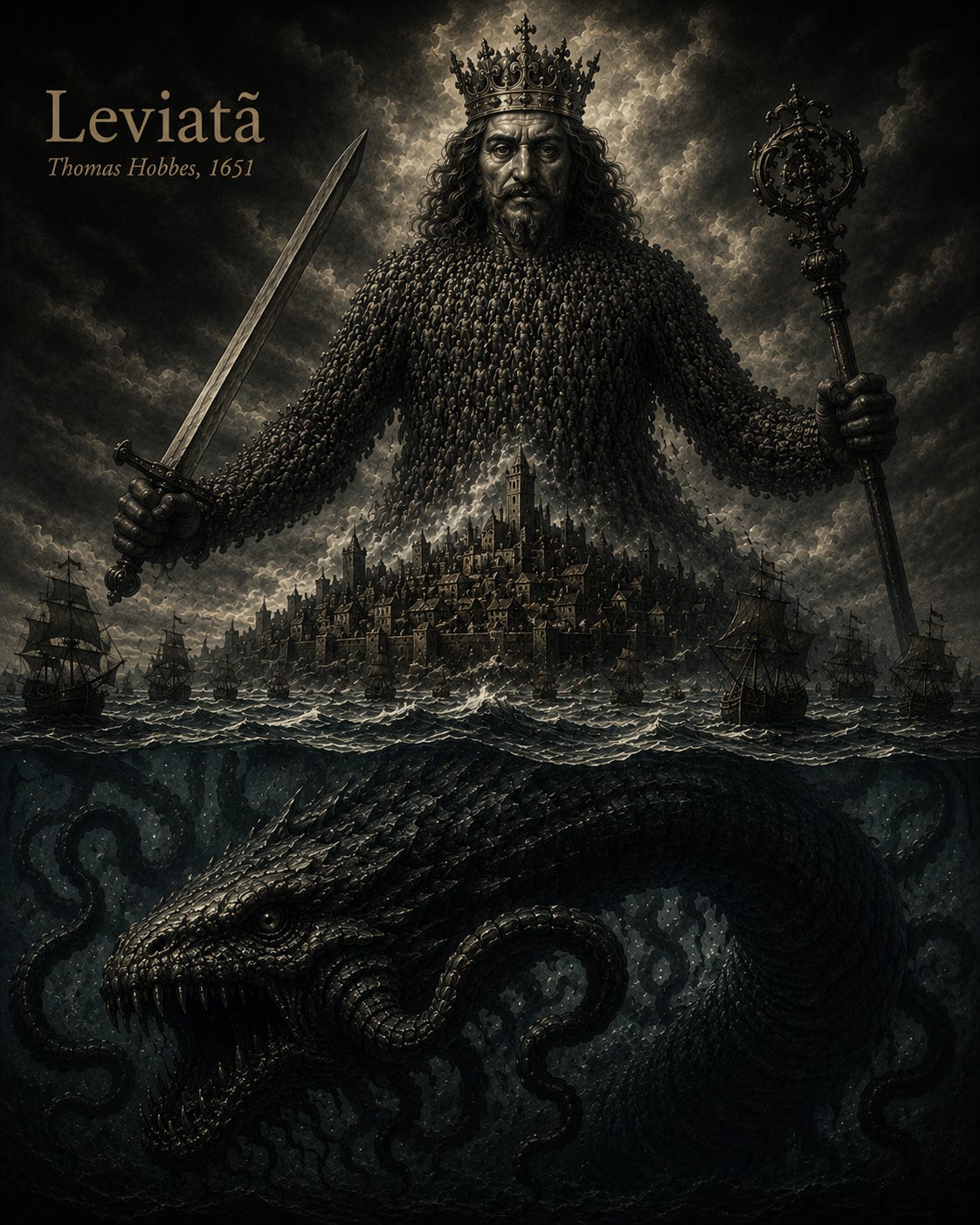
From the perspective of morality and social relations, we must begin with Thomas Hobbes (1588–1679).
Hobbes lived through the English Civil War. He witnessed the execution of King Charles I and the collapse of social order.
It shaped everything he wrote.
Hobbes held a deeply pessimistic view of human nature. For him, man was naturally selfish and violent. Without a strong external authority, human beings would inevitably descend into chaos.
In the state of nature, before organized society, human life would be “solitary, poor, nasty, brutish, and short.”
Each individual acts according to self-interest, producing a war of all against all.
Without a strong authority, life becomes chaos.
Homo homini lupus.
Man is a wolf to man.
Hobbes’ solution was a social contract: individuals surrender their rights to an absolute sovereign in exchange for security and order.
Freedom is partially sacrificed for stability.
Hobbes’ Leviathan draws from the Bible: a colossal sea monster, nearly invincible and beyond human control. A symbol of absolute power and primordial chaos.
The sovereign state possesses near-unlimited authority because, without control, the alternative is disorder.
The Leviathan is the monster we create to protect ourselves from ourselves.
It is a state built by individuals that, once created, comes to dominate them all.
In a certain sense, this moral framework also begins to weaken the foundations of monarchy itself. Political legitimacy no longer derives from the divine right of kings, but from a rational contract between individuals.
The intellectuals of the Enlightenment would build upon these foundations.
Enlightenment
If Newton could explain the movement of planets, why could the same method not be applied to politics, morality, or religion?
Reason became the supreme arbiter of truth.
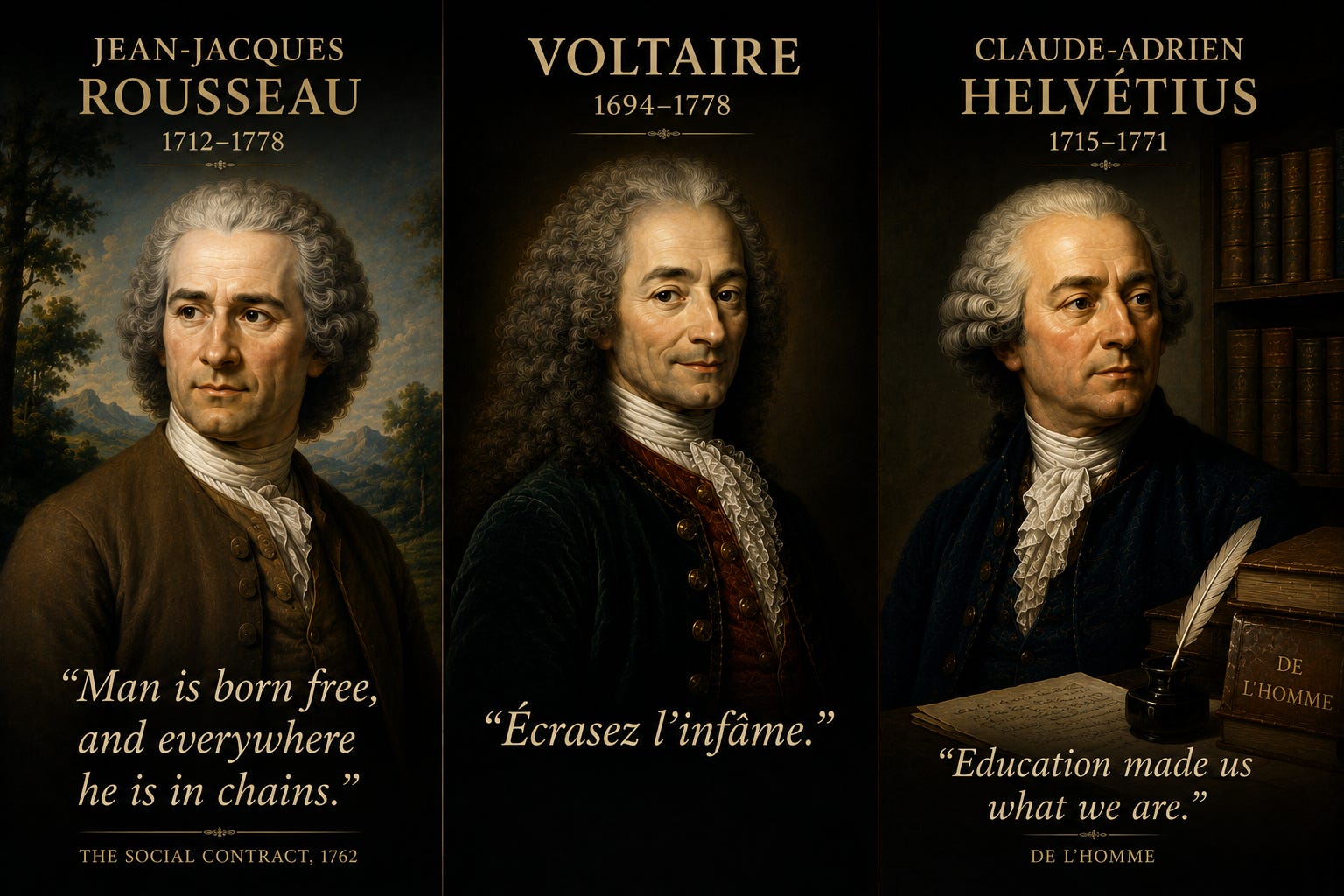
In Reflections on the Revolution in France, Edmund Burke argued that Rousseau, Voltaire, and Helvétius were the three intellectual pillars that most influenced revolutionary thought.
Voltaire dismantled reverence for the sacred and for the Church. Rousseau created a new source of political legitimacy grounded in reason and popular sovereignty. Helvétius defended a mechanistic view of man
Together, they formed something explosive: destroy the old order, consecrate the people as the ultimate source of legitimacy, and reconstruct man through rational design.
Jean-Jacques Rousseau (1712–1778)
While most philosophers of the Enlightenment celebrated progress, reason, and civilization, Rousseau asked the opposite question:
What if civilization itself was the problem?
Man is born naturally good. Society corrupts him.
In 1750, Rousseau won the Academy of Dijon essay competition with the question: “Has the Progress of the Sciences and Arts Improved or Corrupted Morals?”
His answer was simple: corrupted.
He was perhaps the only Enlightenment thinker to argue that the Enlightenment itself was fundamentally mistaken.
Human inequality is not natural. It is created by private property.
Everything that followed from private property — laws, government, war — emerged to protect that original usurpation.
From private property came inequality, luxury, social dependence, and vanity. Together, they produced an artificial, competitive, and morally corrupted humanity.
The logical conclusion soon followed: if society corrupted man, politics must regenerate him.
Rousseau built upon John Locke’s idea that legitimate government derives from the consent of the governed, but pushed the argument much further.
He introduces the concept of the general will (volonté générale): a collective interest that transcends the mere sum of individual interests. Legitimate government expresses this general will.
When it does not, it becomes tyranny.
From this emerges Rousseau’s central idea: The Social Contract.
Each individual surrenders his will to the political body and, in return, participates in the general will. But the general will is not simply the sum of individual opinions. It represents what Rousseau believed to be the true common good.
But here lies the tension Rousseau never fully resolved.
If the general will represents the true common good, what becomes of the individual who refuses to submit to it?
Rousseau’s answer was troubling: he can be forced to be free.
The individual who resists the general will is not being oppressed. He is simply being corrected — brought into alignment with what reason has already determined to be right.
The Jacobins absorbed this logic completely.
Resistance to the republic was not political disagreement. It was moral failure. And moral failure, in a system grounded in rational virtue, could not be tolerated.”
This new intellectual framework was not merely an evolution.
It was a rupture.
And beyond being a rupture, it was another blow against monarchy, the Church, and traditional customs. Sovereign power no longer descended from God or hereditary authority. It now emerged from the people themselves.
Voltaire (1694–1778)
Voltaire was not an atheist. He was a deist, for in the eighteenth century atheism remained a marginal and dangerous position.
Deism offered an intellectually respectable alternative while simultaneously emptying the Church of its institutional authority.
There is a creator God. The complexity and order of the universe, especially after Newton, seemed to require an intelligent cause. But God does not intervene in human affairs. He does not answer prayers, perform miracles, punish sinners, or choose favored peoples.
Therefore, revelation, sacred scripture, sacraments, ecclesiastical hierarchy, and the Inquisition are not divine mandates. They are human inventions.
If God does not communicate through sacred texts or intermediaries, then the Church possesses no special authority over truth. It becomes a human institution like any other, capable of being criticized, reformed, or rejected.
Voltaire attacked several pillars of the Catholic Church: the contradictions of the Bible, supposed miracles, the Inquisition, and religious persecution.
But his most consequential attack for the French Revolution was directed at the clergy as a political class and at the alliance between throne and altar.
If the Church lacked true legitimacy, then the clergy became merely a class that consciously used popular superstition to preserve political and economic power.
And to preserve that power, ignorance among the population was necessary.
The monarchy and the Church sustained one another. The Church legitimized the king’s authority as divine, while the king protected the privileges of the Church.
Voltaire viewed this alliance as the central obstacle to reform. To attack the Church was therefore an inherently political act.
Reason must expose the absurdity of institutions that shield themselves behind sacred authority.
Voltaire’s intellectual assault eventually contributed to the collapse of the Church’s institutional power, even though the Church had long served as one of the central pillars of Europe’s moral, educational, and social structure.
The destruction of the Church’s authority created a vacuum of power.
And freedom alone does not fill a vacuum.
Force does.
So does the Jacobin Terror.
Claude-Adrien Helvétius (1715–1771)
Helvétius believed that human character is the product of environment.
Virtue does not emerge from a noble soul or deep tradition, but from the proper organization of interests.
No one acts out of disinterested virtue. Every action, even those that appear altruistic, ultimately reduces itself to the pursuit of pleasure or the avoidance of pain.
Virtue is simply self-interest properly understood.
For Helvétius, all human beings are born equal in capacity. If the mind is shaped by experience, then differences in intelligence and character are not innate.
His thesis was both materialist and utilitarian: all human mental activity reduces to physical sensation and to the principles of pleasure and pain
There is no immaterial soul. There is no transcendent reason.
What we call thought, moral judgment, and character are merely products of physical experience and unconscious calculations between pleasure and pain.
Education can transform everything.
If character is the product of environment, if men are born equal, and if no transcendent soul exists, then society itself can reshape man through education and the reorganization of incentives.
At this point, politics begins to resemble social engineering.
Man can consciously alter his environment in pursuit of a desired outcome.
Society becomes a laboratory and the citizen becomes raw material.
Jacobinism absorbed much of this logic.
Politics became an instrument for the creation of public virtue.
The republic was expected to form virtuous citizens, and whoever resisted republican virtue became an enemy of the people.
For Burke, this was the ultimate expression of rationalist ignorance: the belief that society could be redesigned through abstract theory while ignoring the complexity accumulated through history.
The French Revolution
The French Revolution was the materialization of those disruptive intellectual theories
The Pandora’s box opened by the Enlightenment unleashed a chain of unpredictable events that ultimately culminated in the guillotine and the Jacobin Terror.
The intellectual architects of the age created a Frankenstein that became too powerful and ultimately impossible to control.
Artificial intelligence may possess the power to reshape our values, redefine our concepts of right and wrong, and generate an entirely new disruptive intellectual framework.
Once again, Pandora’s box may be opened. Once again, humanity may create another Frankenstein.
Without getting too far ahead, since this will be explored more deeply in the next essay, let me briefly illustrate where this argument leads.
Imagine an emerging theory that claims our political institutions are fundamentally corrupted by human error and human bias.
Because of that, they become corruptible, manipulable, and ultimately untrustworthy.
Poorly designed institutions produce impunity, inequality, populism, and eventually collapse. Every great empire in history ultimately fell because of human flaws and human limitations.
Until the emergence of AI, there was no true solution to this problem.
Our institutions inevitably reflected human culture and morality, with all their virtues and imperfections.
But now we may be creating an intelligence more powerful than humanity itself, armed with the accumulated historical experience of civilization.
And if AI eventually becomes more intelligent than humanity, do laws written by humans become obsolete?
If AI can perform every human function more efficiently and more rationally, why should governing remain an exception?
A new theory may emerge:
AI should redesign our institutions according to its superior intelligence and accumulated knowledge. Human bias would disappear. Society would become more equal, less corrupt, and more efficient.
Who will become the new Marx capable of articulating this utopian vision?
Now that the reader understands where this argument is heading, we can return to the moral failures of the French Revolution.
Only then can we properly draw parallels with the modern world.
This section draws heavily from Edmund Burke.
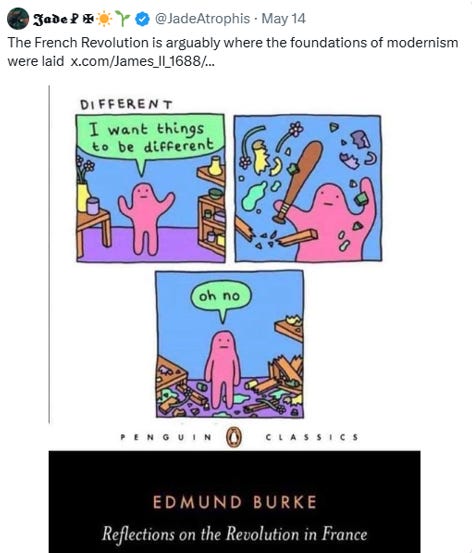
Unlike what many Enlightenment thinkers believed, society is not merely a contract among the living generation. Society is a contract between generations — between the dead, the living, and those yet to be born.
Society reflects our humanity in all its virtues and imperfections. The science of jurisprudence is reason accumulated and condensed across centuries.
Institutions are therefore not mere historical accidents. They embody accumulated historical experience.
Revolution is fundamentally different from reform.
Revolution is easy. It means identifying visible flaws, destroying the pillars of tradition and social order, and replacing them with something new, usually utopian and rationally abstract.
Hominem non sapiente.
They do not understand man.
Revolutionaries understand abstractions, rights, formulas, and numerical equality. But they fail to understand psychology, customs, passions, belonging, tradition, religion, hierarchy, and human identity.
They fail to understand that human beings rarely act according to rational self-interest alone.
As Dostoevsky wrote in Notes from Underground, man would:
“...even risk his cakes, and would deliberately desire the most fatal rubbish, the most uneconomical absurdity, simply to introduce into all this positive good sense his fatal fantastic element.”
Society is not a blank sheet of paper.
Revolutions grounded in abstract rationalism and utopian equality ignored human nature, its incentives, and its contradictions. In the end, they often produced tyrannical governments instead.
Ideological revolutions destroy the invisible preconditions of economic and social order, the very foundations that make order possible
Reform, on the other hand, begins with respect for foundational institutions. It seeks to preserve and improve what has already been built.
Reform respects the intergenerational contract.
Burke did not defend a frozen society. Paradoxically, a state without the means to change also lacks the means to preserve itself.
Stable systems are those capable of absorbing change without collapsing.
True consistency often requires adaptation, flexibility, and institutional evolution in order to preserve continuity of purpose.
Reform is built gradually.
It is better to be criticized for excessive caution than ruined by excessive confidence.
France did not commit the common political error of abandoning morality for self-interest, the idea that the ends justify the means.
It committed something worse.
It sacrificed its own interests in order to sustain the illusion of virtue — a new morality grounded in abstract rationalism.
Burke called this the prostitution of virtue.
Burke feared abstract moral ideologies more than ordinary political corruption. Corruption destroys governments slowly. Ideologies can destroy entire societies quickly.
To be metaphysically true does not necessarily mean being morally or politically true.
The Jacobins murdered the monarchy in the name of the metaphysical ideals of liberty, equality, and fraternity. They assumed that by cutting off the head of power, power itself would disappear.
But power never disappears.
It is merely redirected.
Unfortunately, the vacuum left behind was not filled by liberty. It was filled by force, a consequence of the destruction of moral authority and institutional legitimacy.
Nothing becomes more oppressive or unjust than a weak government, because weak institutions gradually abandon procedure and consistency in favor of arbitrary exceptions and unequal treatment.
The worst form of government is not the corrupt one, but the incompetent one with unlimited power.
The decline of religion, the Church, and traditional institutions during the Enlightenment created a new secular god grounded in economics and science.
What new values will artificial intelligence create to replace them?
The Echoes of the French Revolution
The Enlightenment was one of the great turning points in the development of Western intellectual history. Extraordinary thinkers emerged during this period: Voltaire, Rousseau, Hume, among many others.
Yet Burke’s critique should not blind us to the extraordinary achievements of the Enlightenment itself. Constitutional government, scientific progress, individual liberty, and the modern rule of law were also products of this intellectual revolution.
The danger was never reason itself, but the belief that reason alone could fully redesign human society from first principles.
But intellectual disruptions are not necessarily beneficial. Their secondary consequences are often unpredictable.
As the old saying goes: wars are easier to start than to end.
Intellectual disruptions are seismic events whose consequences echo across centuries.
For many years, it was widely believed that when Henry Kissinger asked Chinese Premier Zhou Enlai about the impact of the French Revolution during a 1972 conversation, Zhou replied:
“It is still too early to say”.
The quote became famous over the following decades as evidence of the supposedly long-term historical perspective of Chinese leaders.
In 2011, however, it was clarified that a translation misunderstanding had occurred. Zhou Enlai was most likely referring not to the French Revolution of 1789, but to the Paris uprisings of 1968.
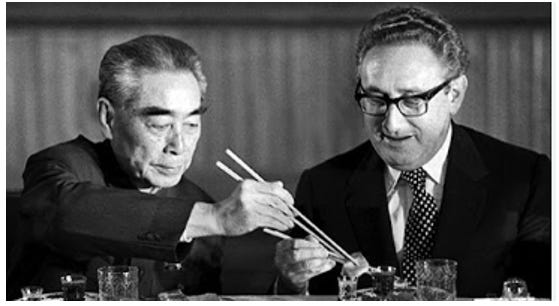
Even so, I believe the original interpretation may still be correct after all.
Hayek argued that the French Revolution created the intellectual environment from which socialism eventually emerged.
And because intellectual history is always path-dependent, socialism first appeared in the form of utopian socialism through thinkers such as Henri de Saint-Simon and Charles Fourier.
Their vision was a society organized rationally and administered by industrialists, scientists, and technocrats rather than by an idle aristocracy.
Over time, these ideas evolved into Marx’s scientific socialism, grounded in a materialist interpretation of history and economics centered on class struggle.
The publication of The Communist Manifesto and later Capital during the nineteenth century would eventually influence Lenin and Trotsky, culminating in the Russian Revolution of 1917.
After the Second World War came the Cold War: the great ideological struggle between capitalism and communism.
And finally, in 1991, the Soviet Union collapsed.
Then came another historical turn.
In the 2000s, China entered the WTO, strengthened its trade position, and became deeply integrated into the global economy.
China evolved into a communist state with capitalist characteristics.
After more than twenty-five years of trade, infrastructure investment, technological development, and industrial expansion, China is now the second-largest economy in the world, potentially capable of surpassing the United States in the coming decades.
Some argue that we are now living through a second Cold War.
It is no coincidence that Xi Jinping referenced the Thucydides Trap during discussions with American leadership.
Perhaps it is still too early to understand the full consequences of the French Revolution.
Parallels Between the French Revolution and the Revolution of Artificial Intelligence
The Enlightenment taught humanity that reason could redesign the world.
Artificial intelligence may become the moment humanity discovers the limits of that belief.
And perhaps, once again, humanity is opening a revolution whose consequences it still cannot comprehend.
Algorithms already influence what we read, what we believe, who receives credit, how insurance is priced, how capital is allocated, and increasingly how institutions evaluate human behavior itself.
AI is no longer merely a productivity tool. It is gradually becoming an invisible layer of institutional decision-making.
Burke’s central warning was not against progress. It was against the belief that accumulated human wisdom could be replaced by any single system of rational design, however sophisticated.
AI may be the first system powerful enough to make that belief seem plausible
In that sense, artificial intelligence may represent something far larger than a technological revolution: a new attempt to reorganize society through rational systems operating beyond ordinary human comprehension.
Christopher Olah, co-founder of Anthropic, recently sat before Pope Leo and a room of cardinals at the Vatican and told them that his team keeps finding “mysterious, even unsettling” things inside their own AI models.
They found things that were not programmed. They emerged on their own.
Olah closed his speech with a request: “We need more of the world — religious communities, civil society, scholars, governments — to take this seriously, to look closely, and to push events in a better direction. We need informed critics who will tell the labs when we are failing. We need moral voices that the incentives cannot bend.”
The man building it is telling us he does not fully understand what he built. And he is asking a two-thousand-year-old institution for help figuring it out.
Prometheus has already stolen the fire. And he is asking us what to do with it.
This essay became much longer than I originally expected. For that reason, I will leave here only the questions I intend to explore in the next part of this series:
Burke argued that it is impossible to prescribe remedies for institutions without first exposing their weaknesses. What remedies will AI prescribe for society?
Rousseau’s volonté générale contained an inherent flaw: who determines what the common good actually is? The people themselves are subjective and contradictory. Now AI may begin defining what is right and wrong.
One of Burke’s central criticisms was that only extreme arrogance could assume a nation is a blank sheet of paper waiting to be redesigned. Will AI inherit this same presumption?
If AI can perform nearly every human function better than humans themselves, could governing eventually become one of them?
Institutions exist to mitigate human error, bias, and individual limitations. They are controllable, procedural, and continuous. Institutions are condensed human rationality and accumulated historical wisdom. AI may become something even more condensed and potentially limitless. Will humanity finally believe it can coordinate society rationally?
Man may no longer be shaped through education, as Helvétius believed, but instead shaped according to whatever AI defines as good.
Will those who resist the rationalization of society through AI eventually be treated as enemies of progress? If so, what will the modern guillotine look like?
Is it better to continue living with human errors or risk entirely new forms of error created by artificial intelligence?
How much decision-making authority are we willing to delegate to AI? Today, algorithms already influence investment allocation, credit approval, insurance pricing, and countless other areas of modern life.
How will we question or audit the decisions of a superintelligent AI if we cannot even understand its reasoning process? Will we simply assume it is correct?
Human societies organize themselves hierarchically for many reasons, one of them being accountability. If AI commits a catastrophic error, who will ultimately be held responsible: the user, the algorithm, or the CEO behind the company?
If God is omnipotent, omniscient, and omnipresent, then AI may become the closest thing to a god humanity has ever created.
Totalitarian regimes historically failed, in part, because they lacked the capacity for total control. AI may become the first true instrument capable of enabling it.
Ídolo